Keeping track of soil moisture is an important part of smart gardening, irrigation automation, and many DIY electronics projects. A Soil Moisture Sensor Module provides a simple way to detect how much moisture is present in soil and send that information to a microcontroller such as an Arduino or ESP32.
This compact sensor module can provide both analog and digital outputs, making it useful for everything from basic wet-or-dry detection to automatic plant watering systems.
Whether you are building a smart garden, an IoT project, an agricultural monitoring system, or simply experimenting with Arduino, a soil moisture sensor is one of the easiest sensors to get started with.
What Is a Soil Moisture Sensor Module?
A soil moisture sensor module is an electronic device designed to detect the moisture level in soil.
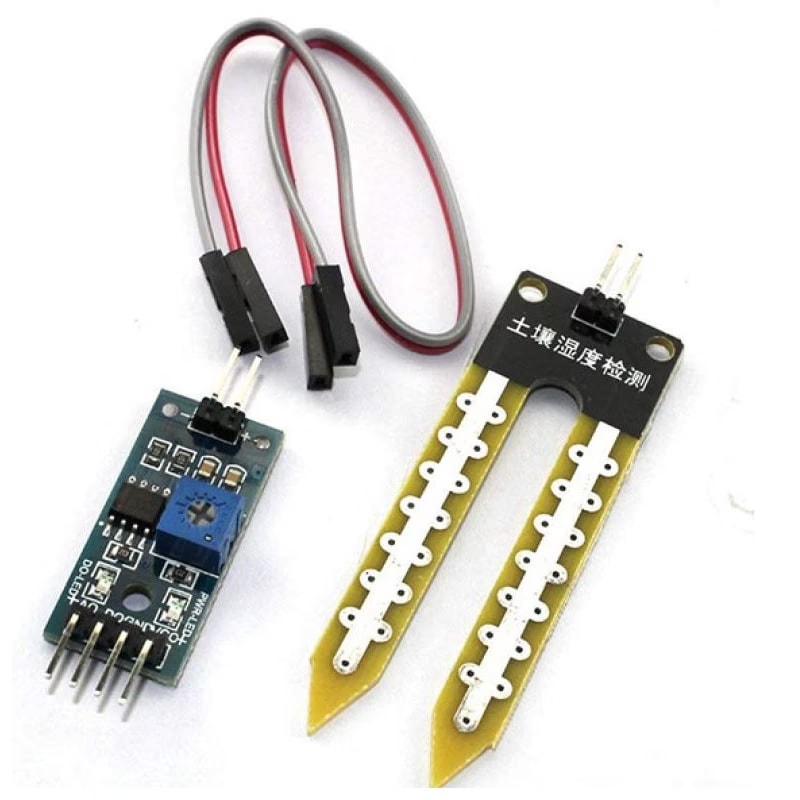
The module uses a probe that is inserted into the soil. As the amount of water in the soil changes, its electrical conductivity changes as well. The sensor detects this change and converts it into an electrical signal that a microcontroller can read.
The module available from Component Wala provides both analog and digital outputs and includes an onboard potentiometer for adjusting the digital detection threshold. It is designed for easy interfacing with Arduino, ESP32 and other microcontrollers.
How Does a Soil Moisture Sensor Work?
The basic operating principle is straightforward.
The sensor probe has conductive surfaces that interact with the soil. Moist soil generally conducts electricity better than dry soil.
When the probe is placed in soil:
- More moisture changes the electrical conductivity between the probes.
- Less moisture changes the conductivity in the opposite direction.
- The sensor circuit converts this change into an output signal.
- A microcontroller can then use the signal to monitor moisture or control another device.
The Component Wala module provides an analog output for continuous readings and a digital output for threshold-based detection.
This means you can use the sensor in two different ways depending on your project.
Analog Output vs Digital Output
One of the most useful features of this type of module is that it provides two outputs.
Analog Output (AO)
The analog output provides a changing signal based on the moisture detected by the probe.
This is useful when you want more information than simply “wet” or “dry.”
For example, an Arduino can read the analog signal and use it to:
- Monitor changing moisture levels
- Display readings on an LCD or OLED
- Record soil conditions
- Create an IoT monitoring system
- Trigger irrigation based on programmed conditions
The exact raw value depends on the sensor, microcontroller and calibration of your setup, so it is generally better to calibrate the sensor for the particular soil and project rather than assuming a universal moisture percentage.
Digital Output (DO)
The digital output works as a threshold-based signal.
The module's onboard potentiometer allows you to adjust the threshold at which the digital output changes state. This makes it useful for simple automation projects.
For example, you could configure a project so that:
Soil becomes too dry → sensor triggers → controller activates a water pump.
This approach is particularly useful when you only need a simple decision instead of a continuously changing moisture value.
Soil Moisture Sensor Pin Configuration
The module has four main pins:
Pin | Function |
|---|---|
VCC | Power supply |
GND | Ground |
AO | Analog output |
DO | Digital output |
The pin configuration is listed directly on the Component Wala product page.
The AO pin can be connected to an analog input on a compatible microcontroller, while the DO pin can be connected to a digital input when threshold detection is required.
Soil Moisture Sensor with Arduino
A common beginner project is connecting the soil moisture sensor to an Arduino board.
The basic concept is simple:
Soil Moisture Sensor → Arduino → Decision → Output
The Arduino reads the sensor and then performs an action based on the result.
For example:
Dry soil → Arduino detects low moisture → Relay activates → Water pump turns on
Or:
Moist soil → Arduino detects sufficient moisture → Pump remains off
For a monitoring project, the Arduino can instead display the sensor reading on a screen or send it to another system.
Because this module offers both analog and digital outputs, you can choose the method that best matches your project.
Example Arduino Project
A beginner-friendly project could be an automatic plant watering system.
The basic hardware could include:
- Arduino Uno or another compatible microcontroller
- Soil Moisture Sensor Module
- Relay module
- Small water pump
- Water container
- Jumper wires
- External power supply where required
The sensor is placed in the soil near the plant.
The Arduino continuously checks the moisture level. When the soil becomes drier than your chosen threshold, the controller can activate the relay and start the pump.
Once the desired moisture level is reached, the pump can be switched off.
This creates a simple automatic watering system without requiring the user to manually check the plant every time.
Applications of Soil Moisture Sensor Modules
Soil moisture sensors are useful in a wide range of electronics and automation projects.
1. Automatic Plant Watering
One of the most common uses is automatic watering.
The sensor can detect when the soil becomes dry and allow a controller to switch a pump on.
2. Smart Gardening
A soil moisture sensor can be combined with an Arduino or ESP32 to create a smart gardening system.
You can monitor moisture levels and create alerts when plants require water.
3. Smart Irrigation
For basic irrigation prototypes, the sensor can provide moisture information that helps determine when irrigation should be activated.
Multiple sensors can also be used in larger experimental systems to monitor different planting areas.
4. Greenhouse Monitoring
Greenhouse projects can combine soil moisture data with temperature, humidity and light sensors to build a more complete environmental monitoring system.
5. Agricultural Automation Projects
Students and hobbyists can use soil moisture sensors to experiment with automated irrigation and agriculture-related IoT systems.
6. Educational and DIY Projects
Because the module is compact and provides both analog and digital outputs, it is a convenient component for learning about sensors, microcontrollers and automation. Component Wala specifically lists agricultural automation, greenhouse monitoring, gardening and educational/DIY projects among its applications.
Why Use a Soil Moisture Sensor?
A soil moisture sensor can make a project much more useful than a simple timer-based watering system.
Consider two approaches.
A timer might water a plant every morning regardless of weather or soil conditions.
A moisture sensor allows the system to react to the actual condition of the soil.
That means your project can be based on a measured condition rather than a fixed schedule.
For learning and prototyping, this makes soil moisture sensing a useful introduction to automated decision-making.
Important Calibration Considerations
A sensor reading should not automatically be treated as a universal percentage of soil moisture.
Different types of soil, probe placement, temperature and other conditions can affect the reading.
For a practical project, it is better to establish your own reference points.
For example:
Reference 1: Measure the sensor in relatively dry soil.
Reference 2: Measure the sensor in well-watered soil.
You can then use those readings to determine the thresholds appropriate for your particular plant, soil and hardware setup.
This is especially important when moving from a basic demonstration to a real automation system.
An Important Limitation of Resistive Soil Sensors
Many low-cost soil moisture modules use resistive sensing through exposed conductive probes.
This makes them inexpensive and easy to use, but continuous electrical current through probes in wet soil can contribute to corrosion over time.
For short-term experiments, classroom projects and basic prototypes, this type of sensor can be very convenient.
For permanent installations, especially systems where the probe will remain in wet soil for long periods, a capacitive soil moisture sensor may be worth considering because it avoids exposed conductive sensing surfaces.
Another approach for resistive sensors is to power the sensing circuit only when a measurement is required, reducing the amount of time current passes through the probes.
Soil Moisture Sensor Module: Key Features
The Component Wala Soil Moisture Sensor Module offers several features that make it suitable for beginner and intermediate electronics projects:
- Soil moisture detection
- Analog and digital outputs
- Adjustable digital sensitivity
- Arduino and ESP32 compatibility
- Compact design
- Low power consumption
- Smart irrigation applications
- Gardening and agricultural monitoring applications
The product is currently listed by Component Wala at ₹31 including taxes, with the module shown as in stock at the time of writing.
Frequently Asked Questions
What is a soil moisture sensor used for?
A soil moisture sensor is used to detect the moisture condition of soil. It can be used for plant monitoring, automatic watering, smart irrigation, greenhouse projects and DIY electronics.
Can I use this sensor with Arduino?
Yes. The Component Wala module is designed for easy interfacing with Arduino, ESP32 and other microcontrollers.
What is the difference between AO and DO?
AO provides an analog signal that can be read for changing moisture measurements, while DO provides a digital threshold signal that can be used for simple wet/dry detection.
Can this sensor control a water pump?
Yes, it can be used as part of an automatic watering system. The sensor itself does not directly replace a relay or power-control circuit; a suitable controller and switching hardware may be required depending on the pump.
Is calibration necessary?
Calibration is recommended when you need meaningful readings for a particular type of soil or plant. Raw sensor values can vary with soil conditions and installation.
Is a resistive soil moisture sensor suitable for permanent outdoor use?
It can work for prototypes and shorter-term projects, but exposed conductive probes can experience corrosion with prolonged powered operation in soil. For long-term installations, consider a capacitive sensor or use measurement strategies designed to reduce probe corrosion.
Conclusion
The Soil Moisture Sensor Module is a simple and useful component for anyone experimenting with Arduino, ESP32, smart gardening, irrigation automation or agricultural electronics.
Its combination of analog output, digital output and adjustable sensitivity makes it flexible enough for both basic wet/dry detection and more advanced monitoring projects.
For beginners, it can be the starting point for a simple plant watering project. For more advanced makers, it can become one part of an IoT-based monitoring system that combines soil moisture with other environmental sensors.
With the right calibration and installation approach, a small sensor like this can turn a basic plant pot into a practical automation project.
Related products
Components that pair well with this guide.